sales@fvfindia.com - GST NO. : 27AABCF6827G1ZL
- Send Email


10,000.00 - 1 Lac / PIECE( + 18% GST applicable)
| Business Type | Manufacturer, Exporter, Supplier |
| Material | ASTM A182 F51 (S31803) / F60 (S32205),ASTM A890 Grade 4A (J92205) / CD3MN,Alloy 2205,1.4462 |
| Color | Silver, Metallic |
| Surface Treatment | Polished |
| Click to view more | |
Product Details
Application
Seawater Cooling Systems,Firewater Systems,Subsea Pipelines,Reverse Osmosis,Brine,Bleach Plants
Certification
CE Certified, ISO 9001:2008, EN 10204 3.1 / 3.2,ISO 9001
Grade
AISI, ASTM, BS, GB, JIS
Country of Origin
India
SPECIFICATIONS
ASME Section VIII, Div 1, ASME B31.3 / B31.1, PED (Pressure Equipment Directive) 2014/68/EU, NACE MR0175 / ISO 15156
Testing
API 598
Warranty
24 MONTH
Size
2" to 24"
Brand Name
FALCON
Shape
Round
Mesh Size
20 TO 400
Surface Finishing
Polished, BRIGHT
Manufacturing Standards
ASME B16.34 , ASME Section VIII, Div 1, NACE MR0175 / ISO 15156, ASME B31.3
Product Code
FVFDSSBS1
Port
JNPT
Payment Terms
L/C, D/A, D/P, T/T
Delivery Time
4 WEEK
Packaging Details
EXPORT WOODEN BOX
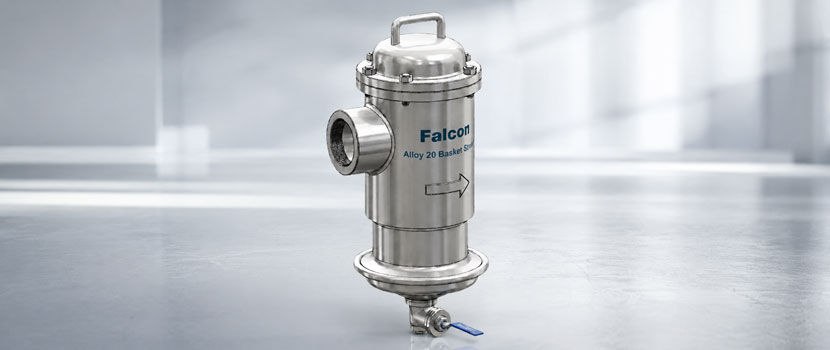
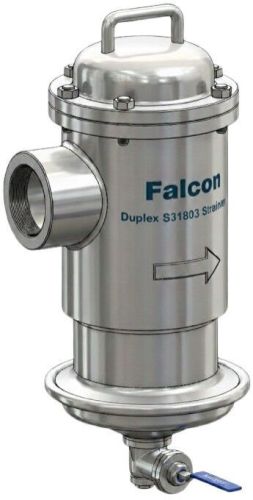
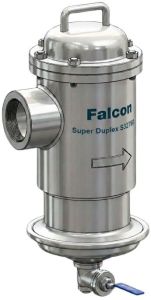
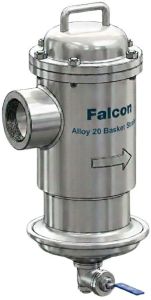
Falcon Duplex SS 2205 Basket Strainers
Our Duplex Stainless Steel 2205 (UNS S31803/S32205) Basket Strainers are engineered for high-performance filtration in the most demanding industrial environments. By combining the best properties of both austenitic and ferritic steels, these strainers offer a superior alternative to standard 300-series stainless steel, particularly in high-chloride and corrosive settings.
### Manufactured & Design Excellence
-
Precision Engineering: Designed in accordance with ASME B16.34 and ASME B16.5 standards to ensure structural integrity under high pressure.
-
Robust Construction: Available in cast, forged, or fabricated bodies, with a standard size range from 15 NB to 1000 NB.
-
Optimized Flow: Features a high filtration area-to-inlet ratio to minimize pressure drops ($\Delta P$) while maximizing debris collection capacity.
-
Ease of Maintenance: Equipped with bolted or quick-opening covers for efficient basket cleaning and minimal downtime.
### Tested Quality & Standards
Every Falcon strainer undergoes rigorous quality control to meet international safety and performance benchmarks:
-
Pressure Testing: Hydrostatic and pneumatic testing per API 598 ensures zero leakage and shell integrity.
-
Material Verification: Positive Material Identification (PMI) testing guarantees the use of genuine Duplex 2205 alloy.
-
Surface Finish: Precision-machined connections and high-grade internal polishing to prevent biofouling and ensure smooth flow.
-
Certification: Full traceability with EN 10204 3.1 Mill Test Certificates.
### Key Material & Application Properties
Duplex 2205 is the "workhorse" grade of duplex stainless steel, offering:
-
Superior Strength: Approximately double the yield strength of SS 316L, allowing for lighter, more durable designs.
-
Corrosion Resistance: Exceptional resistance to Pitting and Crevice Corrosion (PREN ≥ 35) and Chloride Stress Corrosion Cracking (SCC).
-
Temperature Range: Highly effective from -50°C to 300°C; ideal for thermal cycling environments.
-
Durability: High fatigue strength and erosion resistance, extending the service life of downstream pumps and valves.
### Typical Applications
-
Oil & Gas: Offshore platforms, subsea pipelines, and sour gas processing.
-
Marine & Desalination: Seawater intake, cooling systems, and brine filtration.
-
Chemical Processing: Handling of organic acids, chlorides, and caustic solutions.
-
Pulp & Paper: Digester systems and bleach plant equipment.
In seawater environments, standard stainless steels (like 316L) often succumb to localized corrosion and stress cracking. Duplex SS 2205 is specifically designed to bridge the gap between common stainless steel and expensive high-nickel alloys, making it the premier choice for seawater strainers.
Key Benefits of Duplex 2205 in Seawater Applications 1. Exceptional Pitting and Crevice Corrosion Resistance
Seawater is rich in chlorides, which attack the passive layer of most metals. Duplex 2205 has a high Pitting Resistance Equivalent Number (PREN), typically more than 35.
-
The Advantage: It resists the formation of small pits and deep crevices that typically occur under gaskets or accumulated debris in the strainer basket.
2. Immunity to Stress Corrosion Cracking (SCC)
Standard austenitic steels (300 series) are highly susceptible to SCC in chloride-rich environments, especially as temperatures rise.
-
The Advantage: The ferritic-austenitic hybrid microstructure of Duplex 2205 provides near-total immunity to chloride-induced stress cracking, ensuring the strainer body won't fail catastrophically under pressure.
3. Superior Erosion & Abrasion Resistance
Seawater often carries sand, silt, and shells at high velocities.
-
The Advantage: Due to its high hardness and yield strength, 2205 resists "washout" and erosion-corrosion better than 316L. This maintains the integrity of the mesh or perforated basket even in turbulent flow conditions
Looking for "Duplex SS 2205 Basket Strainers" ?
Piece
Explore More Products
Our Blogs