sales@fvfindia.com - GST NO. : 27AABCF6827G1ZL
- Send Email


25,000.00 - 1 Lac / PIECE( + 18% GST applicable)
| Business Type | Manufacturer, Exporter, Supplier |
| Type | Gate |
| Valve Size | 2" TO 48" |
| Material | R50400, 3.7035, ASTM B348, ASTM B338, ASTM B381 |
| Click to view more | |
Product Details
Brand Name
FALCON
Connection Type
Flanged
Pressure Rating
150# / PN 10 / PN 16
Temperature Rating
-250°C TO + 425°C
Actuation Type
PNEUMATIC & ELECTRIC
Usage
Chlor-Alkali & Chemical Processing, Desalination & Marine, Lithium Chloride, Gold & Nickel Leaching
Packaging Type
Wooden Box
Country of Origin
India
Warranty
24 month
Certification
ISO 9001:2008 Certified, CE / PED (2014/68/EU), EN 10204 3.1 / 3.2
Feature
Accurate Dimension, Attractive Designs, Fine Finishing, High Strength, Quality Tested
Flange Drillings
ANSI B16.5 / EN 1092-1
RESILIENT SEALS
EPDM, NITRILE, FKM, SILICONE, PTFE
Testing
MSS SP-81, MSS SP-151, API 598
Design
ASME B16.34
Countries we serve
USA, Canada, UK, Germany, Turkey, Saudi Arabia, UAE, Iraq, Libya, Egypt, Nigeria, South Africa, Russia, Tanzania, Venezuela, Brazil, Australia, Japan, Qatar
Major Cities we supply
Houston, Texas, Chicago, Baton Rouge, Calgary, Edmonton, Toronto, Aberdeen, Abu Dhabi, Dubai, Dammam,Riyadh Jubail, Yanbu, Jeddah, Düsseldorf, Istanbul, Ankara, Moscow, Chelyabinsk, St. Petersburg
Product Code
FVFTIKGV
Port
JNPT
Payment Terms
L/C, D/A, D/P, T/T
Delivery Time
6 WEEK
For your website, here is a professional, original technical brief for Falcon Titanium Knife Gate Valves. Titanium is often the ultimate solution for weight-sensitive applications and environments involving high-strength chlorides.
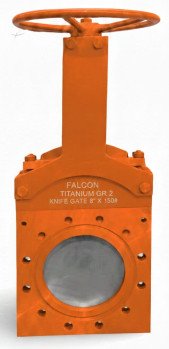
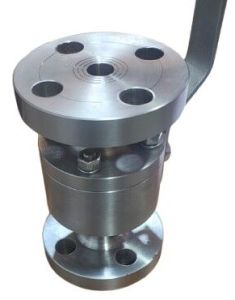
Falcon Titanium Knife Gate ValvesUltimate Chemical Immunity & High Strength-to-Weight Performance
Falcon Titanium Knife Gate Valves represent the pinnacle of corrosion resistance for extreme industrial service. Utilizing Titanium Grade 2 (UNS R50400) or Grade 5 (UNS R56400), these valves provide an inert barrier against the most aggressive corrosive agents that would degrade even high-nickel alloys like Hastelloy.
1. The Titanium AdvantageTitanium’s legendary resistance is due to the spontaneous formation of a stable, protective oxide film on its surface.
-
Chloride Immunity: Virtually immune to pitting and crevice corrosion in seawater, brackish water, and brine, even at elevated temperatures.
-
Oxidizing Environments: Exceptional performance in nitric acid, chromic acid, and wet chlorine gas.
-
Erosion-Corrosion Resistance: The hard oxide layer makes titanium highly resistant to high-velocity flow and abrasive slurries.
-
Weight Efficiency: Titanium is approximately 45% lighter than steel, making these valves ideal for offshore platforms and weight-sensitive piping systems.
-
Precision Machined Gate: We use solid titanium plates ground to an ultra-smooth finish. This minimizes friction against the seats and packing, drastically reducing the torque required for automation.
-
Inert Seating Technology: Available with specialized reinforced PTFE or Metal-to-Metal seats designed to maintain a seal in high-cycle chemical processing.
-
Cavity-Free Body: The internal geometry is designed to prevent "dead zones," ensuring that aggressive media does not accumulate and create localized chemical reactions.
-
Cryogenic Capability: Titanium maintains its mechanical properties in extreme cold, making it suitable for specialized cryogenic chemical applications.
| Parameter | Specification Details |
| Material Grades | Titanium Grade 2 (CP), Grade 5 (6Al-4V), Grade 7 (with Palladium) |
| Pressure Class | ASME B16.34 Class 150, 300 |
| Size Range | 2" (DN50) to 36" (DN900) |
| Standard Testing | API 598, MSS SP-151 |
| Face-to-Face | MSS SP-81 |
| Temperature Range | -29°C to +350°C (subject to seat material) |
Falcon Titanium valves are the first choice for:
-
Desalination & Water Treatment: High-temperature brine heaters and seawater intake lines where zero corrosion is required.
-
Chemical Processing: Handling wet chlorine, chlorates, and hypochlorites in chlor-alkali plants.
-
Pulp & Paper: Bleach plant stages using chlorine dioxide or ozone.
-
Hydrometallurgy: Gold and nickel leaching processes involving high-pressure oxidizing acids.
-
Aerospace & Marine: Applications requiring a combination of high strength, low weight, and salt-air resistance.
To ensure the integrity of our titanium builds, Falcon provides:
-
PMI Verification: To confirm the specific grade of titanium and oxygen content.
-
Specialized Welding: Titanium requires an inert gas (Argon) environment for welding; our certified welders ensure every joint is free of contamination.
-
Dye Penetrant Inspection: Conducted on all sealing surfaces to ensure a 100% flaw-free finish.
-
Traceability: Full EN 10204 3.1 certification provided with every valve.
While Stainless Steel 316L is a versatile material, it has significant limitations in high-chloride or highly oxidizing environments where Titanium thrives.
1. Corrosion & Lifecycle Performance| Feature | Stainless Steel 316L | Titanium (Grade 2/5) |
| Pitting Resistance (PREN) | Moderate (~24-26) | Immune to chloride pitting. |
| Oxide Layer | Chromium Oxide (can be stripped) | Titanium Dioxide (highly stable/self-healing) |
Looking for "Titanium Knife Gate Valves" ?
Piece
Explore More Products

Our Blogs